Published Last updated
Self-storage is often described as apartments without the tenants. The comparison is misleading in one direction and revealing in the other, and both halves are worth understanding before capital goes anywhere near it.
What you actually own
A self-storage facility is a set of enclosed units let to occupants on a month-to-month basis under a rental agreement that is expressly not a lease of real property in most states. The occupant buys the right to store goods in a space. They do not take a tenancy in the way an apartment renter does, and that single distinction propagates through almost everything else on this page.
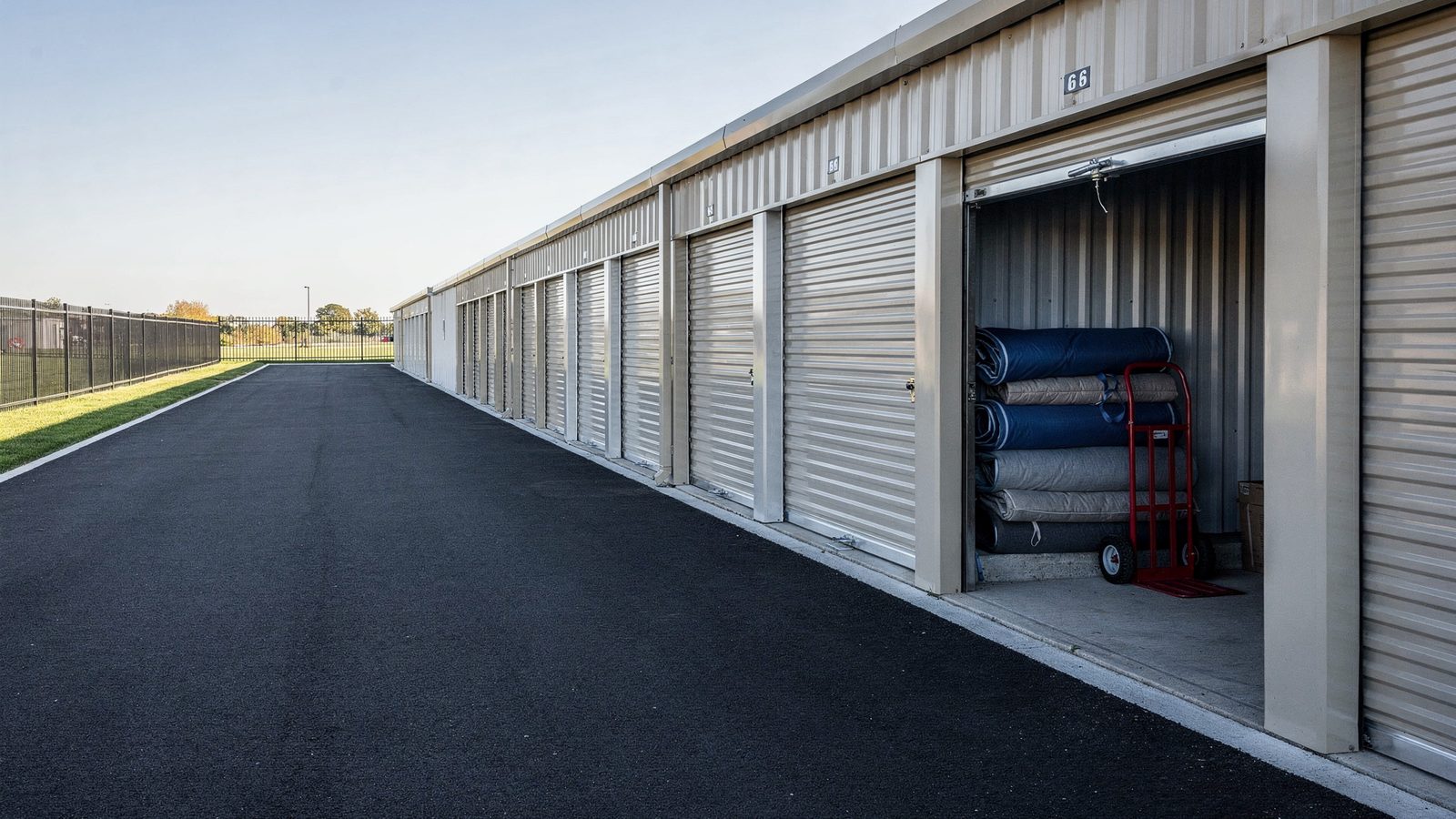
Physically the asset is unglamorous and that is part of the appeal: a single-story drive-up facility is a slab, metal buildings, partitions, doors, fencing, lighting, a gate system and a small office. Multi-story climate-controlled product is more building and more mechanical plant. Neither has kitchens, bathrooms inside units, appliances, or the maintenance load those create.
The operating consequence is a low expense ratio relative to apartments and very low turnover cost. A vacated storage unit is swept and relet. A vacated apartment is painted, cleaned, sometimes re-floored, and sits empty for days or weeks. The offsetting cost is that occupancy churns constantly, so a facility is always leasing.
Revenue is not only rent. Tenant insurance or protection plans, administrative fees, late fees and retail sales are a meaningful share of income at a well-run facility, and they carry very high margins. When you read an offering, ask what proportion of income is rent and what is ancillary, because the two do not behave the same way under stress.
The lien remedy, which is the real structural difference
This is the feature that most distinguishes self-storage from residential real estate, and most investor material skips it entirely.
When an apartment resident stops paying, the landlord must go to court. The process takes weeks or months depending on the jurisdiction, costs money, and the unit produces nothing throughout. When a storage occupant stops paying, nearly every state gives the operator a statutory lien on the property inside the unit and a procedure to enforce it without a judge.
The statutes are state law and they are readable. Virginia codifies its version as the Virginia Self-Service Storage Act. Iowa's sits at Iowa Code chapter 578A, the Self-Service Storage Facility Lien Act. Missouri's is at RSMo section 415.415. The shape is consistent: the operator has a lien on all personal property stored in the leased space for rent, labor and charges, and may enforce it by giving prescribed notice, allowing a cure period, and then selling the goods.
The practical effect on the financial model is large. Delinquency is resolved in weeks by administrative process rather than in months by litigation, and the space is relet rather than held hostage. It is also why a storage rent roll can tolerate a higher gross delinquency rate than an apartment rent roll without the same consequence.
Two cautions. First, the statutes differ materially between states on notice periods, advertising requirements, what may be sold, and what happens to surplus proceeds, so a multi-state portfolio is operating under several different rulebooks. Second, the remedy is only as good as the operator's compliance with it. A lien sale conducted without the statutory notice is a legal problem, not a shortcut, and it is a question worth asking any sponsor: who runs your lien process, and has it ever been challenged?
Month-to-month is a weapon and a liability
An apartment rent roll reprices once a year per unit, as leases roll. A storage rent roll can reprice every month. Operators use that continuously through existing customer rate increases, raising rates on occupants already in place rather than only on new move-ins.
This is the core operating skill in the asset class and it is genuinely a skill. Push rates too hard and occupants leave, and the replacement move-in comes in at the prevailing street rate, which may be lower than what the departing occupant was paying. Push too little and the facility leaves money on the table. Good operators run this as a revenue management problem with data, not as an annual decision.
The liability side is symmetrical and is what a projection often understates. If pricing power runs both ways, then a soft market repricies downward just as fast. Street rates in an oversupplied submarket can fall sharply within a couple of quarters, and because there is no lease term to hold the line, in-place revenue follows. An apartment owner in the same market has twelve months of contractual protection. A storage owner has thirty days.
So when a model assumes steady rate growth, ask what it assumes about street rates specifically, and ask what the facility's in-place rate is relative to street. A facility whose occupants are paying well above street rate has a coming problem, because those occupants will eventually move out and be replaced at street.
Where demand comes from, and how to check it
Storage demand is driven by transition rather than by prosperity. The commonly cited drivers are the ones that begin with D, and they are all changes of state: a death, a divorce, a downsize, a dislocation, plus the more ordinary events of moving house, renovating, forming a household, or a small business needing space it does not want to lease commercially.
The implication is counterintuitive and it matters in the current environment. Storage demand is not primarily a function of how well people are doing, it is a function of how much they are moving. When housing turnover falls, because mortgage rates make moving expensive, a demand driver falls with it. Anyone modeling storage demand off population growth alone is missing the mechanism.
You can check the inputs yourself. Household counts, household formation, renter share and income sit in data.census.gov. Metro employment is in BLS Economy at a Glance. Between them you can form a view on whether the local household base is actually growing and whether people have reason to move.
Trade area is the other half and it is much smaller than people assume. Self-storage is a convenience purchase, so a facility competes within a radius measured in single-digit miles, and in dense urban product considerably less. A metro-level demand statistic tells you very little about a specific site. Ask for the trade area the sponsor has drawn, why they drew it there, and how many competing facilities sit inside it.
Supply is the risk, and it is checkable in advance
The defining risk of self-storage is that it is comparatively easy to build. A single-story facility is a simple structure on cheap land with no plumbing in the units. Where zoning permits it, new supply can be permitted, built and leased inside roughly a year, which is far faster than an apartment building.
That has two consequences. A submarket can go from undersupplied to oversupplied within one hold period, and the historical performance of a facility tells you less about its future than it would in a slower-supplied class. Lease-up of a new competitor is also aggressive by nature, because a new facility discounts heavily to fill, and those discounts set the street rate everyone else is measured against.
Supply is public information and you should ask for it. The Census Bureau's Building Permits Survey covers residential structures, so for commercial storage the better route is the local jurisdiction's own permit and planning records, which are generally searchable. Ask the sponsor how many storage projects are permitted or in planning within the trade area, and ask to see the list rather than a characterization of it.
The question that separates a real answer from a plausible one is simple: name the competing facilities in the trade area, their vintage, their unit mix, their current street rates and their occupancy. An operator who has done the work has that table already.
This is the axis on which storage differs most from the constrained classes. Where storage is comparatively quick to build wherever zoning allows it, industrial outdoor storage is scarce precisely because municipalities have largely stopped permitting the use at all.
The tax profile is weaker than apartments, and that is structural
A storage facility is nonresidential real property. Under the depreciation rules described in IRS Publication 946, nonresidential real property is recovered over 39 years rather than the 27.5 years that applies to residential rental property. On the same purchase price, the building component therefore produces meaningfully less annual depreciation than an apartment asset would.
Cost segregation partially offsets this, and storage is well suited to it because so much of the improvement cost is not the building. Fencing, paving, security systems, gates, signage, site lighting and landscaping are shorter-lived property, and a study that identifies them properly moves a real share of basis into faster classes. The IRS sets out what a defensible study contains in its Cost Segregation Audit Techniques Guide, including its blunt statement that there are "no prescribed qualifications for cost segregation preparers".
Bonus depreciation applies to the reclassified short-life property in the ordinary way. Per IRS Notice 2026-11, the 2025 legislation provides a permanent 100 percent additional first year depreciation deduction for qualified property acquired and placed in service after 19 January 2025, replacing the previous annual phase-down.
The limits are the same as in any private real estate deal, and they are the reason a large first-year loss frequently produces no current benefit. Rental activity is generally passive under IRS Publication 925, so losses offset passive income rather than salary, and your share arrives on a Schedule K-1 with the usual timing and state filing consequences. The mechanics are the same ones set out in cost segregation and bonus depreciation.
The contrast worth holding is with the land-heavy classes. A storage facility is mostly 39-year building, while a manufactured housing community and an RV park are mostly roads, pads and utility runs, which the IRS treats as 15-year land improvements. Same rent, different after-tax shape.
What actually goes wrong
Oversupply in the trade area. The dominant risk, and the one most often waved away with a metro-level statistic. A single new competitor within two miles can reset street rates for everyone.
Lease-up risk on a development or expansion. A new facility fills over a period of years, not months, and the model's assumed absorption pace is an assumption rather than a fact. Ask what comparable facilities by the same operator actually achieved and over what period.
Rate compression running backwards. The same month-to-month structure that lets an operator raise rates lets the market cut them. In-place rates well above street are a liability disguised as performance.
Capital structure. As in every private real estate deal, floating rate debt, an expiring interest rate cap and a maturity arriving at the wrong moment do more damage than operations. That is set out in lender workouts and forbearance.
Operator dependence. Storage rewards revenue management, online conversion and disciplined delinquency handling. The gap between a good operator and an average one is wider here than in apartments, because there is no lease term smoothing the difference.
Against multifamily, honestly
We buy apartments, so treat this comparison as an interested one and check it against the sources listed below.
Self-storage generally offers lower operating expense ratios, cheaper turnover, a far faster remedy against non-payment, and pricing that can be adjusted continuously. Apartments generally offer a better depreciation profile at 27.5 years, contractual rent protection for a full lease term, agency debt availability, and a demand driver that is shelter rather than transition.
The risk profiles differ more than the return profiles. Storage carries greater supply risk and greater rate volatility with less contractual protection. Apartments carry greater regulatory risk, since residential tenancy is regulated and storage largely is not, and greater expense volatility through insurance and property taxes.
Neither is safer in the abstract. What is true is that the two respond differently to the same shock, which is the honest argument for holding both rather than for preferring either. The general framework for evaluating any private offering is in how a syndication works, and it applies to a storage deal without modification.
Where Grey Oaks stands
We do not sponsor self-storage. Grey Oaks buys and operates multifamily. We have no storage offering, no storage track record, and no ability to place your capital into this class. This page exists because investors ask how storage compares to what we do, and a comparison written only by people selling storage is not a comparison.
If you are evaluating a storage sponsor, the diligence is the same as for any private offering. Their prior deals file a Form D notice with the SEC that is public and searchable on EDGAR, the interest you would buy is a restricted security under Rule 144 with the illiquidity that implies, and the SEC's own material on private placements sets out what an exempt offering is and is not. Our full method is how to vet a sponsor.
The questions below are the storage-specific ones we would add to that list.
What to ask a self-storage sponsor
- What is the trade area you have drawn, and which competing facilities sit inside it?
- How many storage projects are permitted or in planning within that trade area, and may I see the list?
- What is the in-place rate relative to current street rate, by unit type?
- What share of revenue is rent and what share is tenant insurance, fees and retail?
- Who runs the lien process, under which state statutes, and has any lien sale been challenged?
- What existing customer rate increase policy do you run, and what move-out rate does it produce?
- On a development or expansion, what absorption pace have your comparable facilities actually achieved?
- What are the loan terms: fixed or floating, maturity, rate cap strike and expiry?
What this is built on
- Virginia General Assembly, Virginia Self-Service Storage Act, Title 55.1 Chapter 29
- Iowa Legislature, Iowa Code chapter 578A, Self-Service Storage Facility Lien Act
- Missouri Revisor of Statutes, RSMo section 415.415, enforcement of lien
- Internal Revenue Service, Publication 946, How To Depreciate Property
- Internal Revenue Service, Publication 5653, Cost Segregation Audit Techniques Guide
- Internal Revenue Service, Notice 2026-11, additional first year depreciation under section 168(k)
- Internal Revenue Service, Publication 925, Passive Activity and At-Risk Rules
- U.S. Census Bureau, data.census.gov
- U.S. Bureau of Labor Statistics, Economy at a Glance
- Investor.gov, Private placements under Rule 506(b) and 506(c)
- U.S. Securities and Exchange Commission, EDGAR full text filing search
-
No question matches that. Try another word, or ask the one that is not on this list.

Ricardo Sanabria · Grey Oaks Multifamily
Answering
Follow-up questions people ask after reading this.
How is self-storage legally different from an apartment?
An occupant buys the right to store goods rather than taking a residential tenancy, so residential protections including rent regulation generally do not apply. State self-service storage acts also give the operator a lien on the stored property and let it be enforced by notice and sale rather than by court eviction.
Ricardo Sanabria, Grey Oaks Multifamily
What is a lien sale?
The statutory remedy for non-payment. The operator has a lien on the personal property in the unit and, after giving the notice and cure period the state statute requires, may sell the goods to satisfy the debt. It resolves delinquency administratively in weeks rather than through months of litigation.
Ricardo Sanabria, Grey Oaks Multifamily
Why does month-to-month cut both ways?
It lets an operator reprice the whole rent roll continuously, which is the main source of operating upside. It also means there is no contractual protection when street rates fall, so revenue can follow the market down within a quarter or two.
Ricardo Sanabria, Grey Oaks Multifamily
What is the biggest risk?
Supply. A single-story facility is comparatively cheap and quick to build, so a submarket can move from undersupplied to oversupplied inside one hold period, and a new competitor discounts heavily during lease-up, which resets street rates for everyone.
Ricardo Sanabria, Grey Oaks Multifamily
Is the tax treatment as good as apartments?
Generally not on the building. Storage is nonresidential real property recovered over 39 years rather than 27.5. Cost segregation helps more than usual because so much of the cost is paving, fencing, gates and site work, which fall into shorter classes.
Ricardo Sanabria, Grey Oaks Multifamily
What drives storage demand?
Transition rather than prosperity: moving, downsizing, divorce, death, renovation, household formation, small business overflow. When housing turnover falls, a major demand driver falls with it, which is why demand can soften in an otherwise healthy economy.
Ricardo Sanabria, Grey Oaks Multifamily
How small is the trade area?
Smaller than most investors assume. Storage is a convenience purchase and a facility competes within a few miles, less in dense urban locations. A metro-level demand figure says very little about a specific site.
Ricardo Sanabria, Grey Oaks Multifamily
Does Grey Oaks offer self-storage deals?
No. Grey Oaks buys and operates multifamily. We have no self-storage offering and no track record in the class. This page is comparative education so you can weigh storage against what we actually do.
Ricardo Sanabria, Grey Oaks Multifamily
8 questions